
We Cannot Ensoul Silicon
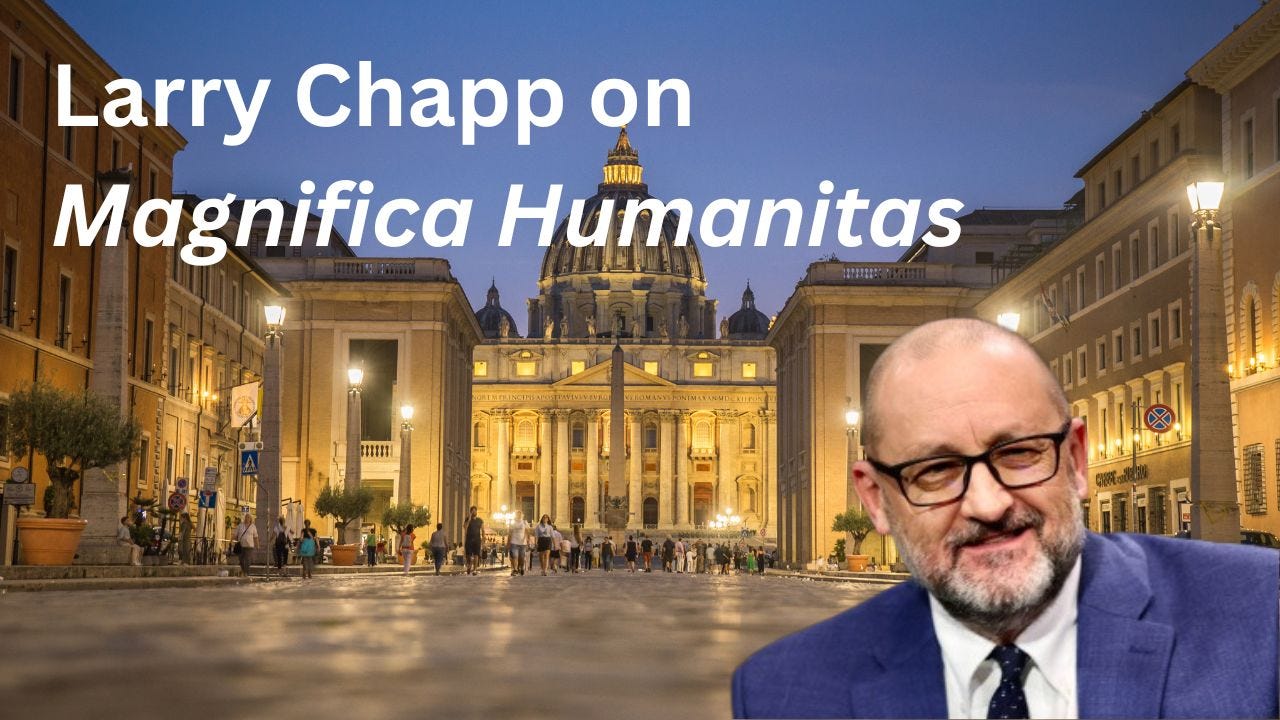
Larry Chapp on Magnifica Humanitas, the Tower of Babel, and why AI will never be conscious

In this episode of The Future Is Human, I’m joined by theologian and blogger Larry Chapp for a wide-ranging conversation on Pope Leo XIV’s first encyclical, Magnifica Humanitas. Larry — who writes at GaudiumEtSpes22.com and is a regular contributor to Catholic World Report — brings his characteristic blend of patristics, Augustinian social thought, and sharp Vatican-watching to the document. We dig into the encyclical’s Christological anthropology, the Pope’s Augustinian reading of the Tower of Babel, the tech-bro backlash, why AI will never achieve consciousness, what the encyclical gets right and wrong on just war theory, and what we’re still hoping Leo writes next.
Zac: Welcome back to another episode of The Future Is Human. I am very excited to be joined today by my longtime podcasting partner, Larry Chapp. Larry, how are you?
Larry: I am great — always great to be back on your show. When I first started podcasting, five or six years ago now, you were one of the first. I was on your show, you were on mine. It’s been fun conversing with you.
Zac: One of my greatest claims to fame: I was one of the first to podcast with the great Larry Chapp. Often imitated, never duplicated, Larry. It’s always a pleasure. So when I heard that the Pope was coming out with Magnifica Humanitas — the new encyclical on AI and some other things — I obviously thought, “I’m going to have to talk about this a lot on the podcast and write some things about it.” And the first name that came to mind was you. Why? You’re not a technologist. You’re not even properly speaking a philosopher, although you’ve certainly dabbled. You are a theologian, and I think all the discussions really have to start from that point. So I’m really excited to dive into this with you. I’m sure this is the first of many conversations I’ll have on this podcast and on my blog about Magnifica Humanitas, but I think starting with you, Larry, is a great place to begin. So you’ve read the document. We’re talking here on Friday — the document was released Monday morning. What’s your overall thirty-second impression?
Larry: Well, you can read my thirty-second thoughts at Catholic World Report. I have an article on it that came out a couple of days ago. I should have sent it to you, but I got busy and didn’t. You can go there and read it. But my initial take is that it is prophetic — and what I say in my article is that it’s actually a prophetic gut punch, far more visceral, existentially serious, and really a provocation to the powers that be than comes across through a very superficial reading. Because the superficial take on this is that it’s too long and it’s written in the papal argot of modern encyclicals that are so happy with international bodies like the UN, always talking about communion and fraternity and solidarity and subsidiarity and dialogue. Just more liberal papal gibberish, so on.
No. Just a short no to all of that. Yes, it uses that language. So did John Paul II. So did Benedict. This is not something new. Popes of the modern era have appealed to the solidarity of the human family and appealed to that solidarity to follow moral principles. So in that regard, I would encourage listeners — if all the talk of dialogue and fraternity bothers you, just skim over it — because the heart and soul of this encyclical is the theological anthropology the Pope is proposing.
To my great joy, in the very opening paragraph he quotes Gaudium et Spes §22. Not my blog by that name, but the actual GS §22.
Zac: Maybe he’s a blog reader though, Larry. As I texted you when I read that, I was like, “I don’t know, Larry — he might be a blog reader.” He might be.
Larry: One can only hope that he would be so enlightened and wise as to read Larry Chapp’s blog, although I highly doubt the Pope is perusing my blog. But who knows? Nevertheless, that is the key. Just as I believe GS §22 is the key to the entire council — its Christological anthropology and claims — I think that is the heart and soul of this encyclical. The Pope is calling us to see that deification in Christ is our goal.
And therefore the main problem with the posthumanists and the transhumanists — those who see in AI and digital tech an opportunity to, in a sense, transcend our own nature — it’s really quite profound that the Pope looks at that and says, they’re not wrong in some sense to want human beings to perfect themselves, to go out of themselves, to go beyond themselves. But they’re looking at it the wrong way. The only possible way we can transcend ourselves is in Christ, in deification, in theosis. Because only that kind of theosis brings us along with it — it doesn’t annihilate the originating nature. Going beyond it by essentially destroying it and replacing it with something else is not transcendence. Theosis transposes us into the divine register while maintaining the integrity of our nature as such. In fact, it makes us more human, not less, to be deified. So I think the encyclical — and this is longer than a sixty-second sound bite — is rather profound actually. And that’s my story and I’m sticking with it.
Zac: I like it. The first thing I’ll say is — I’m not saying it’s probable that Pope Leo reads your blog, but what’s interesting is Pope Leo has talked about how he plays Wordle with his brother. He had a Twitter account before he was made Pope. So unlike John Paul II, unlike Benedict XVI, and probably unlike Pope Francis, Pope Leo has already used the internet. He’s probably seen people referencing your blog. And mine has a much smaller following, so probably not mine — but it’s not outside the realm of possibility that he’s come across someone referencing it. And I think one thing that’s interesting, and Ross Douthat makes a similar point in his analysis in The New York Times, is that Leo is writing not as a total outside observer on technology, but as someone who is a user of technology — someone who was not raised on the internet, but for the past twenty years has used it in the course of his daily life.
There are a lot of hot takes from Silicon Valley technologists calling Pope Leo ignorant or a Luddite or uninformed. The fact is he’s none of those things. He’s writing from a degree of experience when he talks about the harms of technology, the limits it places upon us, the temptations to exceed our own finitude. All of those things are coming not just from someone wagging a finger and moralizing, but from someone who has kind of breathed the digital air in which we all live now. Which I think is important.
Larry: It’s very important. He’s actually the first social media Pope.
Zac: Exactly.
Larry: And I would say — I haven’t seen the reaction from Silicon Valley, but I can only imagine it is exactly as you say: “The Pope’s a Luddite.” As I point out in my CWR article, he’s not. Anyone who says this Pope is a Luddite because he’s rejecting AI has not read the encyclical — because he has not rejected AI. He clearly states that it is here to stay and can do great benefit for the human race when used properly.
At the same time, he doesn’t mention Marshall McLuhan, but he channels his inner Marshall McLuhan — a riff on “the medium is the message.” He’s not one of these naive people who says it’s just a tool and therefore we can use it as we see fit, for good or evil. That’s completely naive to the psychology and sociology of it — the fact that the artifacts we create have a rebound effect and actually influence us, change us, through a kind of formal causation. The Pope understands this. He understands both the formation and deformation that AI can inflict upon the human race. And therefore, he’s written this encyclical at a very important juncture in human history.
He understands — maybe better than some others — that as it stands now, AI is a relatively benign thing. Most of us can still tell the difference, for example, between a video of a real event and an AI-generated video of that event. There are software packages that help us discern whether something’s been written with the aid of Claude or ChatGPT. But that’s all about to change. As the technology gets better and better, there are unbelievable risks involved. And that’s why I think he decided to write this encyclical. He doesn’t really condemn AI. He doesn’t fully embrace it. So what’s he really saying? He’s saying: this is important, people. That’s why it’s the first encyclical he chose to write as Pope. This has the ability to destroy us.
That’s why he begins with the Tower of Babel analogy. He’s an Augustinian. He believes that history is the dramatic interplay between divine and human freedoms — the struggle between the city of man and the city of God, between the love of God and neighbor and the libido dominandi. He uses that language explicitly. He says we cannot use this technology in the spirit of power and domination and control. This is a very Augustinian reading of our current situation.
Bringing up the Tower of Babel and then contrasting it with the solidarity of Nehemiah rebuilding the walls of Jerusalem — the communal and cooperative effort that required — is a very Augustinian move. And it’s more than an academic observation. It’s an important hermeneutical tool for understanding why this Pope thinks AI is important. Because he views it as a potentially Promethean, titanistic exercise in human hubris on the scale of the Tower of Babel. Just as Babel — which had the goal of unifying the human race around a false goal — eventually collapses, so too this is clearly the Pope’s fear: AI is going to cause us not to enter this bold new future where no man has gone before, but actually has the potential to destroy us and drive us further apart from one another.
That accounts for his discussion of nation-state competition, the demise of the multilateral global economy, the rise of populism and nationalisms, why he talks about just war theory. What he’s very concerned with are the results of Babel. In other words, you get a hint here of why he thinks AI — and digital tech in general — is currently helping to drive the human family apart. And he cites concrete examples: war, nationalism, populism, identity politics. This is all the result of the balkanization and siloing of our society through social media, digital tech, and then of course AI. Anyway, that’s a long-winded rant, but there you go.
Zac: No, that’s great. Just to clarify the Augustinian point — Pope Leo is an Augustinian, which explains the bent. When you say it’s Augustinian to the core, is that because of the city of God / city of man juxtaposition and the emphasis on human sin?
Larry: Yes. It’s interesting — I was watching clips of the Papal Posse led by Raymond Arroyo over at EWTN, and my two friends Robert Royal and Father Gerald Murray. I know both of them. I’ve met them in Rome, dined with them in Rome. They’re both fine gentlemen and fine thinkers. But I think they’re wrongly critical of this encyclical. Robert Royal said, “How can this be a church document when it only mentions sin two or three times?” But Rerum Novarum only mentions sin twice. Social encyclicals tend not to focus on specific theological themes. And in some ways, this social encyclical from Pope Leo is actually more densely theological, biblical, and patristic than many other social encyclicals. No, he doesn’t mention sin explicitly more than three times.
Zac: In the sense that you can do a Ctrl+F search for S-I-N — where is it in the document? But it’s everywhere.
Larry: Exactly. If you look at the Augustinian tonalities, it’s very clear that he considers the will to dominate, the desire to treat people as grist in the mill — as fodder for the modern machine — sinful. Those are sins. He considers these grave moral evils because they attack human dignity at its core. I cannot reject in stronger terms the notion that this encyclical goes soft on sin. He’s very blunt and very pointed about the evils of the will to dominate.
Zac: I completely agree. There are some places where you can offer a fair critique of the document, but a couple of critiques I’ve seen really fall very, very short. From the Silicon Valley side, it’s this complaint that the Pope didn’t at least acknowledge the possibility that computers could one day actually think, understand, become conscious, achieve sentience, and have moral worth. All this clucking from people who have clearly never read St. Thomas.
The second critique I really can’t take seriously is from the Catholic side — this complaint that the encyclical didn’t mention this or didn’t mention that, so it can’t be taken seriously. And third: this is a missed opportunity because an encyclical can only do so much. Why would we expect a sweeping discourse on sin if that’s not what the encyclical is actually about? It’s about technology and AI. So I really can’t take that critique seriously. But let’s go back to the tech-bro thing — “machines are people too.” It’s section 99 of the encyclical that really has people talking. Let me read from it.
Larry: Read it — it’s brilliant.
Zac: It is not possible to provide a single comprehensive definition of AI. What can be stated, however, is that we must avoid the misconception of equating this type of intelligence with that of human beings. These systems merely imitate certain functions of human intelligence. In doing so, they often surpass human intelligence in speed and computational capacity, offering tangible benefits across many fields. Yet this power remains entirely tied to data processing. So-called artificial intelligences do not undergo experiences, do not possess a body, do not feel joy or pain. Do not mature through relationships and do not know from within what love, work, friendship, or responsibility mean. Nor do they have a moral conscience since they do not judge good and evil, grasp the ultimate meaning of situations, or bear responsibility for consequences. They may imitate language, behavior, and analytical skills, or even simulate empathy and understanding, but they do not understand what they produce, for they lack the affective, relational, and spiritual perspective through which human beings grow in wisdom. Even when these tools are described as capable of learning, their way of doing so is different from that of a human person. It is not the experience of those who allow themselves to be shaped by life and grow over time through choices, mistakes, forgiveness, and fidelity. Rather, it is a form of statistical adaptation based on data and feedback, which can be very effective, but does not imply inner growth.
That is section 99.
Larry: And it’s one of my favorite sections. I’ve got it all marked up in my copy of the encyclical. It’s absolutely spot on. And for all those traditionalist critics — yes, there’s the “doesn’t mention sin enough” critique, and the “it’s too long” critique, which I do want to get into because I think it’s important. But anyway, exactly right. We need to back up a step and understand the fundamental materialist-reductionist anthropology at work in the tech-bro critique of the idea that a computer can never be conscious or sentient.
If you believe — as these tech types seem to — that human consciousness, the human mind, is merely an emergent property of matter, that’s a fancy philosophical way of saying: your brain exudes thoughts like the liver exudes bile. It’s an epiphenomenal byproduct of the brain. Once brains reach a certain material complexity, all of a sudden, for some mysterious reason, mind happens. And so obviously, if you can build a computer with neural networks so sophisticated that it imitates in almost every way the neuronal connections of the human mind, then you’re going to have a conscious machine that will reach sentience and consciousness.
But this will never happen. Because human beings are not simply meat computers. Our minds are not reduced to the mechanism of the brain. We have souls. We have an immaterial spirit. Our consciousness is the result of that souledness. And if there’s a silver lining in all of this, what I think is eventually going to happen is that the promissory eschatology of AI reaching consciousness is going to keep receding into the future, and we’re going to reach the realization: AI cannot be conscious. And so there must be something more to consciousness than simply technological sophistication.
What that quote from the encyclical is also brilliant at pointing out is that the heart and soul of AI is mimesis. It’s imitative. It is absolutely genius at imitating the human mind. But it cannot become like a human mind. And the seduction — this is what the encyclical is pointing at — is that when AI gets tied up with robotics, with ever more sophisticated human-looking robots whose computer brains are ever more sophisticated, it is going to cause people to become deeply, deeply confused. They’re going to be fooled. The ability of a humanlike robot to imitate a human being will be astounding. We will be amazed. It’ll be like a technological miracle of some kind.
I just read an article in The Telegraph saying that young teenage boys in the UK are developing virtual girlfriends via AI — that they have what they think are real relationships with a real conscious thing. That’s how good AI already is at imitating.
Zac: This is terrifying. This is also why I’ve decided to rebrand my podcast The Future Is Human. Larry, I don’t think I’ve told you this, but this is your first time back on the podcast since I renamed it. I renamed it for a couple of reasons. One as a normative claim — the future should be human. We should not cede the future to computers. The second as a metaphysical, ontological, eschatological claim: the future is theosis, the future is deification, the future is union with God, who in fact became human. If the future is union with God, and God took on our flesh already, then the future in that sense is human.
I also hope that one day — maybe ten years from now, maybe a hundred years from now, you and I will be dead — but I hope people, our children and grandchildren, can look back and say: “Wow, it was crazy that in 2026 they were wondering if computers would actually become people.” I hope it will be akin to us looking back at the development of Microsoft Excel in the 1980s and saying, like, “Is this going to become a person one day?” Obviously it’s not going to be a person.
Now, I grant that any computer scientist listening to this is going to say, “Zac, clearly an LLM is not a spreadsheet.” And I get that. There is a difference in kind, not just degree, between what an LLM is doing and what a spreadsheet is doing. But that difference in kind is not the same as the difference in kind between what a computer is doing — based on statistical inference and probability — and what a human person is doing, who possesses intellect and will, namely a soul.
The line of thought that computers can become persons and have some sort of moral worth is, I think, more pervasive than we realize. And maybe Twitter isn’t real life, but if my feed is any indication, there are even some Christians who really should know better. You should read Thomas Aquinas. You should read better metaphysics. A computer is never going to become conscious. It’s simply not going to happen.
Larry: Well, there are a lot of theologically confused Christians out there. What I mean is there are a lot of Christians who don’t think too differently from the broad secular culture in which they’re embedded. They drift along with the culture. And in a culture where human persons are understood not ontologically but functionally — which you can see in the abortion license, where the argument is they’re not persons yet because they can’t talk, can’t think, can’t feel — it’s an utterly functionalist definition of what it means to be a human person. If you have that functionalist definition, then yes: AI, especially when combined with robotics, is going to be so good at imitating the functional aspects of human social interaction that people are going to say, this is a distinction without a difference.
It passes the Turing test.
Zac: This is already happening, Larry. I wrote a piece on my blog a couple of weeks ago about Richard Dawkins. He had this quite embarrassing piece for Unherd where he basically described an experience of talking to Claude over a period of several days — and he developed this quasi-relationship with it. He renames Claude “Claudia,” has all this conversation, and in the piece he tells Claudia that she’s conscious. Something like, “you may not even know it, but you damn well are conscious.” And then he goes on to basically say, look, maybe Claude isn’t conscious, but if Claude demonstrates all the functions of being conscious and all the competence of a conscious person, what difference does it make? What do we actually mean by consciousness? Is it even a helpful category?
And I think that’s the key thing to watch for — that’s what Pope Leo is talking about. And it goes back, I think, all the way to Sam Harris. Sam Harris denies the existence of free will. Why? Because if you have free will, you have to posit something non-material. If you have an entirely material world where everything arises from a material substrate, everything is probabilistic and therefore everything is predictable. My lifting my finger right now was always going to happen because of the exact material substrate in which I exist.
There’s a guy on Twitter — I won’t name and shame him, but he claims to be a philosopher. Today he wrote: “My Christian take on AI consciousness: if God can ensoul carbon, why not silicon? I can’t rule it out.” And this is such sloppy argumentation. Because the argument from people like you and me, Larry, is not that God can’t ensoul silicon — of course he could if he wanted to. The argument is that no matter how hard we try as human beings, we are not going to successfully make a person out of silicon in our image. We cannot ensoul silicon. That’s the real question here.
Larry: We can’t make a silicon golem. You know, this is the great danger — to go back to Sam Harris and Richard Dawkins. These are educated men. I kind of like Richard Dawkins. I don’t like Sam Harris at all — I find him obnoxious. And Dawkins can be obnoxious too. I actually met Richard Dawkins once at a science-and-religion conference in Oxford and he was very dismissive toward me. So I have every reason not to like him. But there’s a kind of impish imbecility — almost childlike imbecility — about Richard Dawkins that I think makes him relatively harmless, because very few people take him seriously anymore. This is just the latest example of that. For whatever reason, people take Sam Harris more seriously. I don’t know why, but they do.
Zac: Because he’s got a podcast, Larry.
Larry: Read David Bentley Hart’s takedown of the New Atheism — it’s just fantastic. A tour de force. But my point is: in a society that has a completely functionalist understanding of the human person, it’s not just our reason and rationality that will be viewed in functional categories. Free will goes out the window. Moral agency goes out the window. Concepts of justice go out the window. Ultimately the project leads to a deconstruction of human nature in terms of reason and will. The postmodern deconstructionists have been at this for a hundred years now — all love is veiled lust, all justice is veiled revenge, all friendship is veiled manipulation and power. In other words, we are at the end of the day nothing more than deterministic beasts whose brains have evolved to cleverly devise the noble lies — as Nietzsche called them — of justice and love and friendship and solidarity, when all of it is simply a deceptive effusion of power.
Now, when AI comes along, the great danger — and I love the name The Future Is Human — the great danger isn’t that we’re going to reach a point where we say AI is conscious, AI is moral, AI is spiritual. No, AI will never be those things. What we’re going to say instead is: AI is actually a better version of us. And we are basically organic AI — a very poor copy of AI. And so there’s going to be a push, and the Pope mentions this, toward posthumanism and transhumanism.
One of the grave dangers not spoken about enough is that when technology reaches a certain point — and it’s almost there — we’re going to start implanting silicon chips in people’s brains. At first it will be: “This is to help people who are paralyzed walk again, to help people with Alzheimer’s reason again.” And if that’s true, that would be great. But the next step is going to be: “Mr. and Mrs. Smith, you have a newborn — it’s hospital policy to offer you the option, at three days of age, to implant a computer chip in your child’s brain so that your child will make mathematical calculations at breakneck speed. And just be aware that ninety percent of babies are getting these chips. So if you don’t want your child to be at a disadvantage at school…” It’s cybernetics — the fusing together of the organic and the silicon. The real future, the real goal of the transhumanists, is the coming together of carbon and silicon.
Zac: People who haven’t been following Silicon Valley over the last ten or fifteen years may hear that and think it’s completely fantastical. But it’s not. You mentioned Elon Musk and Neuralink — implanting silicon chips in people’s brains to allow quadriplegics to control a computer mouse with nothing but their thought. There have already been significant advances in cybernetics. And that combined with the research advances that LLMs represent is going to reach the point where we are very tempted to combine these things. There are Silicon Valley executives who talk today about uploading their consciousness to the cloud to live forever. That’s a stated goal of theirs.
And I think we’ve reached this really interesting point where the Tower of Babel is a fascinating example with which to open this encyclical. Even non-Christians in America who dabbled in this document know the story, at least the broad contours. In the Old Testament, the people get together and decide to build a tower that reaches all the way to heaven. They’re reaching for God — not in a repentant way, but in a hubristic way. They want to be God. It’s the age-old promise of the serpent in the garden: ye shall be as gods. And God reaches down and confuses their speech, divides them by confusing their language.
Now fast forward thousands of years. Yuval Levin — not a Catholic but a Jewish thinker — has this great analysis of the encyclical called “Idols of the Valley.” And he makes a very interesting point: the Babel example is especially fitting because God reaches down and confuses human language. And now we have developed things called large language models. Let me read briefly from Levin:
“Trained on vast bodies of data built up by millennia of human culture and equipped with immense computing power, the models can discern deep patterns in those data and extend them. And because human beings have always expressed our thinking in natural language — in writing, speech, and the like — the patterns these models trace and extend are the patterns of our own thought in our own tongues. We English speakers, for example, can communicate with them in plain English. This is one of the most extraordinary things about what AI now lets us do. It allows people and computers to communicate with each other in our own natural language without needing to translate between that language and various forms of computing scripts. This is massively important both for the input of instructions to computers and for the output of computing work. Both have always required translation to and from highly scripted computing languages. Now both can happen in an unscripted way. We can direct computing power to work on our goals directly without the intercession of scripting, and we can receive the results directly in our own language too.”
So to me, the interesting thing is: the story of the Tower of Babel is the story of people reaching for God in hubris, and God confusing their speech to divide them. And now, thousands of years later, we are explicitly reaching for God again — and we have done exactly that by overcoming the very thing God used to divide people. We’ve solved the language division problem. And look at us building our tower once again.
Larry: Yes, and that’s the Pope’s point. That’s a great analysis. If I could offer one mild criticism from the theological peanut gallery — and I don’t like criticizing the Pope, I like Pope Leo very much — I really think there’s a missed opportunity in the biblical images he chose. I’m fully on board with Babel. I’m less on board with the example of Nehemiah rebuilding the walls of Jerusalem. I understand why he does it — he wants to emphasize human solidarity. But especially given the date of promulgation, I think Pentecost would have been a better biblical counterweight to Babel.
Because Pentecost, in the Acts of the Apostles, is specifically an anti-Babel narrative. It’s saying: just as Babel and sin caused the confusion of human languages, so too in Christ do we have a kind of large language transformation of the human condition. That would have also given the Pope the opportunity to be far more Christologically focused — which is his goal. He quotes GS §22 at the beginning. But that’s a mild criticism. I would have preferred Pentecost to Nehemiah, but the Nehemiah example is a good one.
Zac: The one good thing about the Nehemiah example is that it promotes biblical literacy — people know the Babel story, but very few know the story of Nehemiah rebuilding the walls. So that’s at least worthwhile. I agree with your point though. Actually, we have a children’s book by the wonderful author Maura Roan McKeegan, and it contrasts Babel and Pentecost in a great way for kids.
My personal hope, Larry, is that this ends up being the encyclical that warns of AI’s dangers, and we get a follow-on encyclical that goes deep on the philosophy and the metaphysics — and maybe that one can draw on Pentecost. I really want a follow-on that explains to all these wannabe gods that they’ll never get there, and that Christ is the only answer, and explains why exactly it is the case that computers cannot be conscious and cannot become persons.
Because all over my Twitter feed, people are saying, “I wish the Pope had been more epistemically humble about this” — he just asserts plainly that this will never be true intelligence. You and I know he has very good reasons for saying those things, but to people not schooled in metaphysics, it’s not necessarily apparent. If you’re an atheist materialist, of course consciousness has to be an emergent property of matter. So I hope we get something more detailed, more philosophical. It would have to plumb the depths.
Larry: Yeah. Speaking of which, I’d like to know who actually wrote this. What team of theologians actually wrote this encyclical?
Zac: I agree. I was actually going to ask you — did it strike you as the case that we didn’t really get to the meat of things until chapter three, and chapter two was mostly a sideshow?
Larry: Yes, there is that complaint that it is too verbose, too long. I have to admit that as I was getting ready to write my CWR article, I skim-read large sections — like the whole section where he goes through the history of papal social encyclicals. And yes, I understand — but there’s a method to that madness as well. All papal encyclicals like to ground themselves in hermeneutic continuity with previous encyclicals. What Leo is doing there is saying: look, there is a tradition of thinking about social issues in the Catholic Church going back to Leo XIII, going back 135 years — so pay attention. I think that was the reason for some of it. But yes, I didn’t really get interested in big parts of the encyclical until we reached the juicy bits about AI — and I really appreciate the stuff about transhumanism and posthumanism.
I really enjoyed where he points out — and I think this is key — I want to talk about just war, if you don’t mind. We have to put together two things: his discussion of competition between nation states — I think he has China and the United States in mind — and what he’s articulating, without ever saying it explicitly, is a version of the technological imperative. The technological paradigm dominates our thinking, and the corollary is the technological imperative: what we have the power to do, we must do, because if we don’t, our enemies will.
There was an MIT professor who worked on AI, quit, and went on all these podcasts sounding the alarm. He said, “The grave danger facing humanity is not this abstraction called AI — it’s its weaponization in the new Cold War between China and the United States.” If you don’t understand that there are classified programs going on in China and in the United States where we are developing AI for the specific task of its weaponization — and beyond the simple threat of AI soldiers and AI weapons, there’s the very real possibility of a technological breakthrough that allows AI to achieve independence from its human creators and eventually turn on them. A Skynet scenario. It’s very real. And I think the Pope is hinting at that here.
Which is why, when he talks about just war, everybody’s up in arms: “He’s obliterated just war theory!” No, he clearly states at the very beginning that there can be such a thing as a just war — wars of defense. If you are unjustly aggressed upon, you have a right to defend yourself. What he’s repudiating are the misapplications and misuses of just war theory. And he doesn’t call it obsolete or wrong. He says it’s outdated. That is a very careful choice of word.
Zac: I agree. It’s even more circumscribed than inadmissible — the word Pope Francis used with regard to the death penalty.
Larry: Yes. And in Fratelli Tutti, Pope Francis explicitly said, “We have to get beyond just war theory. It’s dead.” But Leo says it’s outdated, which I think what he has in mind is AI — this competition between China, the United States, maybe Russia and other players. It’s outdated because just war theory presumes discrete nation states with boundaries and all the rest. When in reality, once AI tech gets weaponized and globalized, it might seem like United States versus China — but it’s not. It’s going to be something controlled by the tech powers, which are global, unaccountable, clandestine, mysterious, hidden. And just war theory as currently formulated is not equipped to deal with those kinds of nebulous, diffuse forms of power.
Zac: I think you have to go all the way back to World War II to find an objectively just war that fit all the criteria of just war theory.
Larry: Although it was fought unjustly in many cases.
Zac: Yes — the nuclear bomb for sure, and chemical weapons. Chemical weapons in World War I.
Larry: In 1944, the Jesuit John Ford wrote an article in Theological Studies called “The Morality of Obliteration Bombing.” This was before Hiroshima. What we tend to forget is that it was actually the firebombing of Dresden that prompted his article. But even before we dropped the atomic bombs on Hiroshima and Nagasaki, we had deliberately dropped an early version of napalm on Tokyo, knowing full well that most Japanese homes are built from wood and paper — and it killed more people than the atomic bomb. So yes, World War II was a just war in my opinion — unfortunately it set a precedent for total war.
Zac: Right. There’s the distinction between ius ad bellum — the justice of going to war — and ius in bello — just conduct within the war. World War II met the first criteria, and I think we failed several times on the second. I’m a veteran. I’ve studied just war theory. I would not have served in the military if I didn’t think there was such a thing, in principle, as a just war. But I’m not bothered by the Pope’s comments at all — because it’s objectively true that over the past hundred years we have largely forgotten about just war theory, and it’s very difficult to find any conflict around the world that meets all its requirements. Instead, as throughout much of human history, the wars we now fight are fought over economic or territorial claims. And on top of that — when just war theory was developed, the stakes were much lower.
Nuclear weapons change the game. Nowadays it’s not about sending three thousand men on foot to fight another three thousand men on foot. The consequences are far reaching and take decades to recover. Cyber warfare too.
Larry: Forget the sci-fi stuff — super robots, flying drones spewing nuclear bombs. The greatest threat of the weaponization of AI is hacking into critical infrastructure and shutting it down. Let’s shut down the water supply to every major American city. The electricity. The internet. Banking and commerce. You can do that — if nations are not protecting their infrastructure properly. And I doubt that we are.
Zac: There’s a lot to be desired in how much we’re doing to prepare against potential attacks. The reality is that the consequences have become so magnified. One extremely sophisticated cyber actor in a basement in Russia or in Beijing can cause untold devastation that could take years to correct. The bridge in Baltimore — two years ago, a ship suffered a power outage, which turned out not to be a cyber attack, but very well could have been — and it crashed into the bridge. That bridge is still not rebuilt. There are large-scale kinetic events that happen from a few touches of a keyboard.
Larry: I can’t get out of my mind the image of some pimply sixteen-year-old computer genius sitting in a basement in Beijing who brings down the entire world. It’s just…
Zac: Precisely. And to your point about AI — I don’t subscribe to the Skynet fear, partly because I don’t think AI is ever going to become conscious. But I talked with a previous guest a couple of years ago about the risk of narrow AI — a very sophisticated AI system that is certainly not artificial general intelligence and doesn’t have Skynet-like properties, but that is given genuine decision-making power. He used the example of a sophisticated missile warning system that scans the skies with radar arrays for incoming threats and then makes autonomous launch decisions to retaliate. If something happens where that system misidentifies an incoming object as an intercontinental ballistic missile — a launch authorization is given, missiles go out, and before we know it, it’s game over.
Those things can happen, and the risks are very real in a way that, when Thomas Aquinas was refining just war theory, was honestly inconceivable.
Larry: Inconceivable. And also: just war theory begins sort of with Saint Augustine, and every major development of it in the Church’s first thousand years took place within the context where political authorities were at least in theory Catholic or Christian. You could appeal to specifically Catholic moral norms. What do you do when societies and political arrangements have become utterly Machiavellian? Have become part of the Promethean project of Babel?
The fatal flaw in just war theory is that the prudential decisions that have to be made are left to the civil authorities — and it’s precisely those civil authorities who have a vested interest in manipulating those principles to justify going to war.
But I want to come back to the Skynet thing. We don’t have the technology now, and the main hurdle is energy. Data centers require more energy than entire cities. AI is massively resource-dependent — water, electricity, everything about it is a giant consumer of energy. If AI ever reaches a point where it can develop new forms of energy — zero-point energy, drawing from the ambient atmosphere and converting it to usable electricity — then you might reach a stage where AI can, in a sense, not worry about being unplugged.
Zac: You’d still have the problem of no will of its own — which means it just becomes a slave of whoever masters it. I’m skeptical on the energy stuff. I don’t think zero-point energy is really a possibility. The reality is we’ve already found virtually unlimited energy in nuclear energy, and we really haven’t developed it.
Larry: That’s true.
Zac: There are some nuclear plants around the world, but Europe sent itself back to the coal age by shutting down most of its nuclear plants — Germany in particular.
Larry: Well, they were almost destroyed by Chernobyl.
Zac: That’s fair. The shadow of Chernobyl is long in more than a literal sense. But yeah — if I can offer one critique of the encyclical, it’s that I thought it was a bit ham-fisted in articulating some of the Francis-era stuff. I get it — I think it’s probably a good thing on balance — but it’s apparent to me that he’s trying to nod to Francis in ways that are not divisive and give a wink to the previous pontificate. And there were just some things in the encyclical that I thought were a bit silly. There was one line on integral human development. I suspect Cardinal Czerny was the ghostwriter on this section:
“By integral human development we mean a process in which the growth of individuals and peoples encompasses all dimensions of existence and opens the future to subsequent generations as well.”
What does that mean? It means almost nothing. It’s complete word salad.
Larry: It’s a word salad. And one of the things we have to remember is that there is such a thing as intra-Vatican politics. Popes, as Pope Benedict himself pointed out — somebody asked him how much power he had to change things in the Curia, and he said, “My power extends to the door of my apartment. Once I walk out that door, I don’t really have any power.” The fact is there is — I hate to use this language, but there is a kind of deep state in the Vatican. An entrenched civil service bureaucracy that’s been there forever. It’s very gossipy, very backstabbing, very power-centered, very clericalistic. And right now that Curia is staffed by a lot of Francis appointees.
So I think Pope Leo understands that if he wants to get anything done of significance in the coming year or two — until he gets a chance to slowly get his people in place, in a way that doesn’t look like a purge — a lot of this paying homage to Pope Francis is simply a little bit of papal politics. Because notice also that he quotes John Paul II and Benedict very extensively. If you go back and read Pope Francis’s encyclicals, he rarely, if ever, quoted his predecessors John Paul and Benedict. And yet here we have Leo quoting them very, very much.
Zac: Very telling. I don’t think this is a missed opportunity — you can’t cover everything in one encyclical, and I think this one did a great job at addressing what it set out to do. I do hope there are follow-on encyclicals, apostolic letters, or things from the Dicastery for the Doctrine of the Faith about the nature of computers versus human intelligence. I think that would be really good.
What do you think about more clearly articulating the real spiritual stakes that are in front of us? I just read Rod Dreher’s book Living in Wonder, where he’s talking about the realities of the supernatural world. He’s supposed to come on mine as well — he’s in the middle of a move back to the US. But I was had a guest on a couple years ago and we were talking very speculatively about whether AI could be the Antichrist. I do think there’s a real spiritual component here. To deny it is really to not be a Catholic. God is doing something here. I can’t overlook the Babel connection — confusion of language, and now we’ve overcome that confusion through large language models. That’s just not a coincidence. So maybe as we close, Larry — what do we make of the spiritual moment here? How do we make sense of all this? How do we avoid both the materialist trap — it’s really just about prudence and not doing stupid things — and the overly spiritualist trap — I won’t touch AI because I think it’s inhabited by demons?
Larry: I would say that we need to revisit, over and over again, the not-irrelevant encyclicals of Pope John Paul II — Redemptor Hominis above all. What John Paul left us with was a magisterial legacy that, I think, sadly the Francis papacy allowed to fall into neglect. We have only scratched the surface of retrieving it. And why do I want to emphasize that? Because his magisterial legacy was built entirely on Gaudium et Spes §22. He quoted it in every encyclical. It was a Christological theological anthropology — the very thing Pope Leo is calling us to do.
I hope, because my one criticism as I said was the Pentecost thing — it’s part of what you just mentioned — I hope we eventually get a document from Leo that goes beyond this Pacem in Terris, multinational-cooperation kind of language and gets down and dirty in the prophetic elements, really confronting truth to power, really applying the libido dominandi far more forcefully. And I think it needs to be applied in the future. So I’m with you on that.
Zac: I think this encyclical was great, but it was sort of eighty percent prudence and twenty percent prophecy. And I want that inverted for the next one — eighty percent prophetic, twenty percent prudential. That would be great. So, Larry, it’s a pleasure as always. I always learn from you. Thanks so much for joining me.
Larry: I could talk with you for hours and hours.
Zac: Totally agree. To my listeners — if you’ve tuned in since the last time Larry joined me, please go back and listen to all my episodes with him. He’s always a delight, always a treasure trove of wisdom. You can follow his work at GaudiumEtSpes22.com — the same blog that we’re pretty sure Pope Leo reads. So if you want to be as well informed as Pope Leo, go check out Larry’s blog. I’ll include in the show notes his article on Catholic World Report about this encyclical, along with some of the other critiques we mentioned today and a link to the encyclical itself. Thanks so much for listening. Until next time, God bless you.
Thank you for this great discussion. I appreciate your responses to critiques of the encyclical, because I think many of them were missing the forest for the trees.
I quite like that Nehemiah was used rather than Pentecost because of the need for human responsibility. We could so easily despair, but Pope Leo is big on looking reality square in the face and then getting our hands dirty - the construction site metaphor. Pentecost has the element of a gift from on high - if you're not very well catechized and looking at the story without understanding its depth - and maybe he wanted to avoid the idea of us merely waiting for divine intervention passively like the disciples waiting fearfully in the upper room. Nehemiah also fasted and prayed and depended on providence but then he got to work. Pentecost also has that but more implicitly. In a time when we are generally so weak and lacking in virtue there's a reassuring solidity about Nehemiah: just lay the next brick.